


In high-end equipment manufacturing, machining complex rotary parts presents a dual challenge of efficiency and precision. In conventional solutions, an external positioner usually requires an additional PLC (Programmable Logic Controller) to control its rotation. While this setup meets basic rotation needs, it raises the cost of purchasing external hardware, and it becomes a "hidden bottleneck" that slows production-line cycle times when handling multi-turn continuous machining, complex curved-surface coordination, or frequent program switching.
CRP has recently launched its new "External Axis Infinite Rotation" function. It is not merely a low-level upgrade to the control algorithm but a deep restructuring of traditional machining processes. Through software-level enhancement, the function removes the limit on the number of turns an external axis can rotate. It provides a high-precision, continuous, and stable "all-in-one" intelligent manufacturing solution for complex process scenarios such as cladding, welding, quenching, and cleaning.
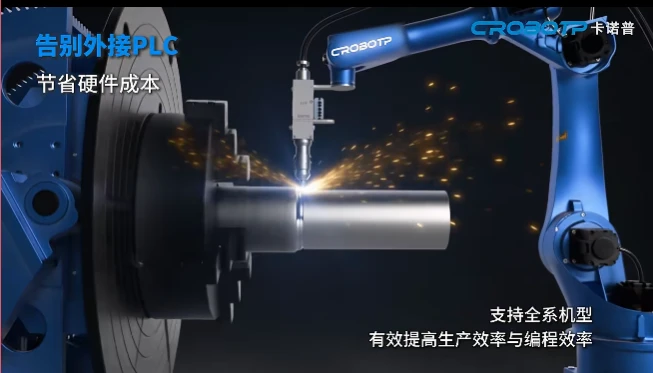
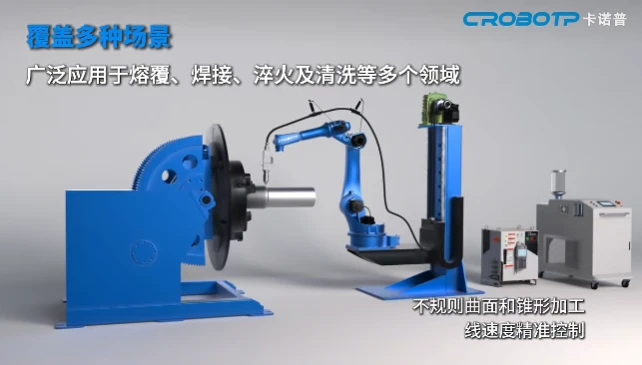
I. No External Hardware, Direct Cost Savings
In a traditional system architecture, enabling a positioner or external axis to rotate continuously often requires an additional PLC control cabinet, which not only increases equipment procurement costs but also makes later maintenance and wiring more cumbersome. CRP's Infinite Rotation function removes this barrier at its source. The system drives the external axis directly through the robot controller, replacing the traditional PLC control mode and saving customers this hardware cost. The function also supports the full range of CRP laser-series robots, effectively improving on-site production efficiency and programming efficiency.
II. Intelligent Reset: No "Reversing" After Multi-Turn Machining
The biggest pain point of multi-turn continuous rotation is this: after a workpiece has rotated dozens of turns, how can the robot return quickly to the starting point without having to "reverse" all the way back?
To solve this problem, CRP has built an intelligent reset logic into the system. In motion commands (MOVL/MOVC), users simply enter the "external axis rotation turns" or the "external axis angle." As the robot moves toward the target position, the system dynamically zeroes the external axis (resetting the accumulated multi-turn value to zero in one step). It is like giving a machine tool "stepless speed change" and "one-click return to zero," which eliminates back-and-forth "reversing" altogether.
More importantly, with the "JointReset" command, the system can precisely move the rotary axis to a "reference position within a single turn" or to a "user-defined current angle." In effect, after the equipment has traveled a long way, it returns to the origin instantly, with no need to retrace its path.
As a result, after multi-turn machining is complete, the equipment does not need to rotate in reverse. Once the robot returns to the starting point and the external axis returns to its angle within a single turn, the equipment can proceed directly to the next process. This preserves absolute positioning accuracy while significantly reducing non-machining time.
III. Dual-Mode Operation: Complex Curved Surfaces Are No Problem
In industrial settings, workpiece shapes vary enormously. For laser machining of products such as discs, crankshafts, conical parts, and blades, a single rotation mode is far from sufficient.
CRP's Infinite Rotation function fully supports both coordinated and non-coordinated operating modes.
Coordinated mode: While the external axis rotates, the robot maintains its end-effector speed along the trajectory, enabling coordinated trajectory motion over complex curved surfaces. Put simply, the laser head "moves and rotates at the same time," with speed and trajectory perfectly matched. For cladding processes, a constant end-effector speed means a stable molten pool and a uniform, dense cladding layer.
Non-coordinated mode: The external axis speed is controlled independently by adjusting it as a percentage, flexibly matching the cycle-time requirements of different processes.
In addition, the function supports precise linear speed control, and the rotation speed of the external axis can be set separately. For irregular curved surfaces and conical machining, the system keeps the rotation speed uniform and controllable. Combined with CRP's integrated wire-feeding system and stepper/servo push-pull wire-feeding technology, it is fully compatible with laser welding, cutting, cladding, quenching, cleaning, and hybrid welding processes.
IV. Minimalist Programming, Lower Barrier to Entry
Complex functions should not bring a complicated user experience. When a cylinder needs to rotate multiple turns, operators do not need to perform tedious manual teaching or write code. They simply set the number of external axis turns directly in the program, or specify the angle of rotation required. The barrier to entry is extremely low, and on-site workers can get started after only brief training. The command logic is clear, intuitive, and easy to use, and the whole process from trajectory planning to motion execution flows seamlessly.
V. Applications in Progress
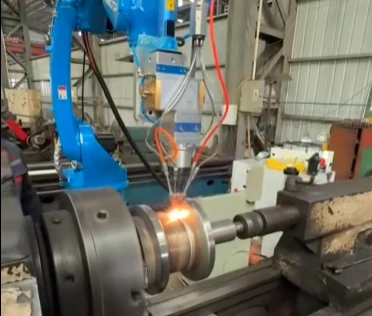
In laser cladding, laser-series robots working with external axis infinite rotation perform continuous spiral cladding on shaft and roller parts: the workpiece rotates without pause, and the cladding path is continuous with no breakpoints. In roll laser quenching, laser-series robots use this function to achieve a continuous, evenly distributed quenching band across the roll surface.
From cladding and quenching to cleaning and welding, this function is useful in any scenario that requires continuous rotation of an external axis. From "usable" to "easy to use," and then to "efficient and precise," the evolution of CRP's robot technology has always revolved around the real needs of the production floor. Its core purpose is singular: to make on-site operation simpler and customers' production more cost-effective.